
Day 1: Delhi- Mandawa (Nawalgarh) – 5 hours / 240 kms
Arrival in Delhi. 5 to 6 hours drive by minibus or jeep to the Shekawati region.
Breakfast enroute restaurant.
Visit of the fort and some havelis in Mandawa, a charming town built in the 18th century. Afternoon visit Nawalgarh founded in 1737 by Nawal Singh, its painted Haveli’s, explore the town.
Dinner at hotel.
Overnight at Nawalgarh
Day 2: Mandawa (Nawalgarh) to - Bikaner (Barasingsar)
Breakfast at hotel.
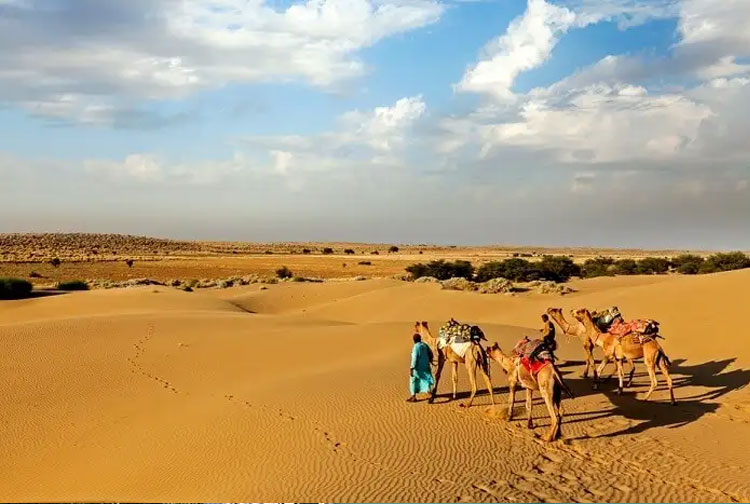
Check out and drive to Bikaner, on the way visit some beautiful havelis in Fathepur, famous for its wall paintings and continue to Bikaner: leave the highway and enter in rural area for 35 kms in the region of Bishnoi, where wewill sleepin small and peaceful dune and will meet the chamalier who will be waiting there to lead the trek for next 2 days.
Lunch & Dinner while on trek
Overnight at Camp
Day 3: Camel trekking
Breakfast at Camp.
Trek in Bishnoi region who are the followers of lord Vishnu and are strictly vegetarian and environmentalist, Basically peoples are farmers, they are very gentle and hospitable, one can visit the family to see the real life of Bishnoi community. While trekking we will pass through several villages, farms where peoples can be seen working on it with their colourful clothing, wild life as Antilope (Gazel) which are protected by Bishnoi community jackel and variety of birds can be seen. Scattered Tinny traditional huts in the farm where trekkers take advantage to shelter in and kitchen team prepare the hot lunch which create feeling as if we are lost in the world of semi desert.
Lunch & dinner while on trek.
Overnight at Camp
Day 4: Bikaner / Jaisalmer (Golden city) – 290 kms / 5 hours
Morning breakfast at campsite. Leave early morning from the campsite
Drive back to hotel for wash n change.
Visit the world famous temple of rat (Karni Temple at Deshnukh) and drive to Bikaner to join the main highway.After a 6-hour drive, you will reach Jaisalmer in the afternoon, bewitching citadel at the gate of the desert. It is a former step to the caravan roads, a very charming place: you can have a stroll in the market; see the sunset near to Gadi SAR, a kind of lake.
Lunch enroute or at hotel
Founded in 1156, Jaisalmer in Rajasthan paints a real picture of Arabian Nights. It is one of India's most exotic and unusual towns, and probably the most perfect Rajput walled city of all. Jaisalmer is a beautiful town dotted with forts, havelis and palaces. The beautiful havelis, known for their explicit artworks and carvings are yet another interesting aspect of the desert city. Ages have gone by and the monuments of Jaisalmer have withstood the buffeting winds of the desert all through. You can let your eyes caress the sloppy sand dunes while you ramble your way in a camel safari.
Dinner at hotel
Overnight at Jaisalmer
Day 5: Jaisalmer
Breakfast at the hotel
The day after, visit the Jains temples and the havelis in the low city.
Later visit of Jaisalmer Fort, which is the second oldest fort of the state and offers surely a vision of beauty. Known as Sonar Quila or the Golden fort, rising from the sand, the mega structure merges with the golden hues of the desert ambience and the setting suns in its most colourful shades. The fort is in itself a whole township that consists of palace complex various security sources and the havelis of rich merchants carved with an incredibly light touch, several temples and the residential complexes.
Lodruva, 18 kms away, has the ruins of the earlier capital of Jaisalmer, and Jain temples, which are now being re built as the only reminder of its past splendour
Also visit Amar Sagar a beautiful formal garden and Bara Bagh: a fertile oasis with a huge old dam. Visit cenotaphs.
Dinner at hotel
Overnight at Jaisalmer
Day 6: Jaisalmer / Jodhpur (Blue city) - 275 kms / 6 hours
Breakfast at the hotel.
Check out and drive to Jodhpur (6 hours). On the way we will visit some rural villages and meet the people, afternoon arrive Jodhpur.
Check in and Lunch at hotel.
Jodhpur is the second most populated city in Rajasthan stand at the edge of Thar Desert. One of the most impressive fort, built in the 15th century, dominating the city built in red stone, visit of the Mehrangarh fort, and the Jaswant Thada white marble tomb, then stroll in the Sadar Bazar of the blue city. Jodhpur is fondly refered to as the ‘blue city ’because of indigo coloured houses in the old town. Traditionally, blue signified home belongs toBrahmanas. One can view nicely these houses from the ramparts of the Meharangarh, which looms high above the buzzing city.
Post lunch visit of Bishnoi Village, inhabited by the Bishnoi community, this village will provide you with a flavor this community (followers of Guru Jamboji of the 15th century, and his 29 principles) who have protected nature for more than 500 years and are arguably the 'Premier ecologists of the world'. Bishnoi’s are strong lovers of trees and animals and are responsible for the very survival of species like the Black Buck Antelope (India's most beautiful antelope and a rare and protected species today). They share a beautiful relationship with this special animal, wherein the antelope stays close to Bishnoi habitation, never leaving it, and displays complete trust in the Bishnoi people.
Overnight at Jodhpur
Day 7: Jodhpur to Ranakpur Via Jojawar 150kms
Breakfast at hotel.
Mehrangarh Fort, Perched on a 150 m high hill fort was founded in 1459. The display of Canon is one of the rarest in India. Battle scars of canon ball hit by attacking armies of Jaipur can still be seen on the second gate. Within the fort are some magnificent palaces with meticulously carved panels, latticed windows or "Jarokhas" with evocative names. The chambers of Moti Mahal, Phool Mahal, Sheesh Mahal, the Sileh Khana and the Daulat Khana are noteworthy for the splendour and glamour of a bygone era
Jaswant Thada: The graceful marble cenotaph of Maharaja Jaswant Singh II. His son Maharaja Sardar Singhji in the memory of Maharaj Jaswant Singhji II of Jodhpur. The main memorial has been built like a temple with intricately carved marble stone that is sculpted by the genius artesian. A visit to this structure is through the rocky hills giving it a secluded and a mystic aura.
Departure post lunch, on the way we will visit some tribal villages in Jojawar on the foot of Arawali and continue to Ranakpur, one of the most important pilgrimage place for the Jains, situated in a quite and beautiful remote valley of the Mount Arawali. The main telmple is Choumukha or four-faced temple, which is dedicated to Adinath. It has been built in 1439, superbly crafted and well-kept temple has 29 halls and 1444 pillars and donot have similarity to each other. Night in hotel in peaceful valley
Overnight at Jojawar
Day 8: Trekking in the Arawallis Mountains
Breakfast at the hotel.
A 5 to 6 hour walk in the region to explore the rural hamlets, life of the habitants and wild life in sanctury,
Morning village visit and train ride
Visits the neighboring tribal and Rebari settlements where Enthusiasts could visit on the back of famous Marwari horse or opt for four wheel driving (Jeep safari).
One of the major attractions is the train ride (narrow gauge), which takes you through the picturesque Aravallis. Passing through tunnels and bridges overlooking the beautiful lake and the forest around it. This gives you a good insight into local tribal life.
Overnight at Jojawar
Day 9: Jojawar / Udaipur (Surface / 145 kms / 3 hrs)
Breakfast at fort.
Check out and drive to udaipur after 3 hours driving through the mountains road, we reach one of the most charming cities in Rajasthan: Udaipur is situated on the bank of Pithola lake and high hills around visit of the City Palace walk in the bazar (Optional boating on the lake). Night in a charming haveli with white marble facing to the lake.
Udaipur, the 'City of Dreams' and also known as Venice of the East, is interspersed with shimmering lakes, marble palaces and fountains and is often referred to as the most romantic city in India. It was built in traditional Rajput style in 1559 A.D. by Maharana Udai Singh and was originally the capital of the State of Mewar. It's beautiful lake setting; graceful architecture, bustling bazaars and historical past make Udaipur rather special.
Evening experience Bagore Ki Haveli, Bagore-ki-Haveli is located by Lake Pichola, at Gangaur Ghat. Amar Chand Badwa, the Prime Minister of Mewar, built it in the 18th century. The massive palace has over a hundred rooms that display costumes and modern art. The glass and mirrors in the interiors are structured in classical haveli style.
Bagore ki Haveli is a popular evening show with variety of Indian dance. These cultural events take approx. 1-2 hr and enjoy the magic show, puppet dance, folk dance and more. Indian folk and tribal dances are simple dances with minimum of steps or movement and performed for every possible occasion to celebrate the arrival of seasons, birth of a child, a wedding and festivals. Be amazed by the skill and imagination of the beautiful dances!
Overnight at Udaipur
Day 10: Udaipur
Breakfast at the hotel
Morning visit of City Palace & Museum, Jagdish Temple, Sahelion ki Bari.
The grand City Palace towers over the Pichola Lake. Maharana Uday Singh initiated in the construction of the palace but succeeding Maharanas added several palaces and structures to the complex retained a surprising uniformity to the design. The main part of the palace is now preserved as a museum displaying a large and diverse array of artefacts, the Crystal Gallery having breath-taking collection of crystals.
JagdishTemple -The exterior and the plinth are covered with base relief of alligators; elephants, horsemen and celestial musicians rise in tiers. Chanting, bells and music can be heard throughout the day.
Sahelion Ki Bari - was built in the 18th century by Maharana Sangram Singh. The delightful gardens appear discreet and in impeccable taste. The foundation of the Sahelion ki Bari functions solely by water pressure and no pumps are used
Afternoon free time at leisure
Evening Lake Pichola and Jag Mandir
Evening boat ride in the Lake Pichola on a common boat and visit Jag Mandir. Lake Pichola derives its name from Pichola Village was submerged and Maharana Udai Singh enlarged the lake after he founded the city .Jag Mandir is the other island palace in Lake Pichola, which was constructed by Maharana Karan Singh. The island has some striking carving including a row of elephants that looks as though they are guarding the island. The exquisitely carved chhatri in grey and blue stone is another example.
Opitonal Excursion to Nagda & Eklingi
Optional Excurion to Chittorgarh
Optional Excurison to Ranakpur
Overnight at Udaipur
Day 11: Udaipur / Pushkar (300kms / 6 hours)
Breakfast at hotel.
Check out and drive to Pushkar, check in hotel and visit the holy town.
According to the legend, the sacred lake of Pushkar sprang up at the spot where Brahma (Lord of creation) dropped a lotus flower from the sky,It is very important pilgrimage centre of Hindu and its saying that devotee should visit at least once in life time, There are large number of Sadhu who mainely congregate around the lake and temples. Sevaral Ghats runs to the lake where pilgrims are constantly taking bath in holywater of lake
Pushkar is world famous for its spectacular Camel fair, which take place here in Month of kartika (on Full moon) according to Hindu calendar.
AM & PM Visit to the famous Pushkar Fair. This ancient religious town of Pushkar is transforms into a spectacular Fair Ground, as rows of make shift stalls display an entire range of objects of art to daily utility stuff. Decoration items for Cattle, Camel and women, everything is sold together. The Camel and Horse races have crowds to cheer. Camel judging competitions are quite popular with animal lovers. Each evening brings different folk dances and music of Rajasthan, performers delivering live shows to the roaring and applauding crowds.
Lunch & dinner at camp
Overnight at Pushkar
Day 12: Pushkar / Jaipur (Surface / 125 kms / 3 hours)
Breakast at camp
Check out and drive to the Pink city, capital of the State. Transfer to hotel, and then visit the Amber fort, 10 km far from Jaipur: it is an impressive fort built in a scenic place. This has been the capital of the Kachwahas for 5 centuries until Jaipur, built again in 1727, became capital itself. In the afternoon, visit has the observatory and City Palace. Night in a charming Rajput palace, converted in family hotel.
Overnight at Jaipur
Day 13: Jaipur / Fathepur Sikri / Bharatpur(Surface / 210 kms / 5 hours)
Breakfast at hotel & check out
Morning experience Amber Fort on Elephant Back.
Later drive to Fathepur Sikri, 4 hours drive. It was the former capital of the Mogul Emperor Akhbar in the 15th century.after lunch drive to Bharatpur, one of the most important ornithological reserves in India with more than 400 different kinds of birds! You can visit by walk or cycle.
Lunch at hotel in bharatpur
Bharatpur, which is also called the Eastern gateway of Rajasthan, was found by Maharaja Suraj mal in 1733 AD. The town of Bharatpur was basically a royal hunting retreat. Bharatpur is however, more known due to its proximity to the Bharatpur Bird Sanctuary (also known as Keoladeo Ghana National Park), which is a bird watchers paradise.
Dinner at bharatpur
Overnight at Bharatpur
Day 14: Bharatpur / Agra (Surface 60 kms / 1 hour)
Breakfast at hotel.
Morning visit Bharatpur Birds Sanctuary. The sanctuary covers 30 square Kms of low-lying marsh-land and is connected by paths sand canals running through the park which make for pleasant walks or richshaw rides. About 350 kinds of birds have been sighted here, of which about 150 kinds wing their way to the sanctuary from as far away as China and Siberia. Before the monsoons, hundreds of these exotic birds roost and nest here, and building activities start on the ‘babool’ and ‘Kadam’ trees of the park.
After a 1:30 hrs drive, reach Agra. Discover the Taj Mahal, sumptuous white marble tomb, one of the most beautiful pieces of Mugal art. Shah Jahan Emperor has built it in 17th century for his wife. Visit Agra Fort (Friday Taj Mahal Closed)
Evening free for shopping or OPTIONAL Evening (0630 – 0830 PM) Mohabbat The Taj Live Show it’s a splended Bollywood Drama which starts at 0630 PM at Kalakri Centre. Spend your evening enjoying the amazing Mohabbat The Taj show that depicts the romantic love story of Emperor Shajahan and his beloved wife Mumtaz Mahal in the famous theater Kalakriti Cultural and Convention Center. The creative dance and dramatic lighting will blow you away with the 12’ x 12’ Taj Mahal replica as well as the lavish lifestyle of the Mughal Empire. The live show is in both Hindi and Urdu languages and interpretation is available in English, French and German through headphones.
Dinner at the hotel
Overnight at Agra
Day 15: Agra / Delhi (Surface / 240 kms / 4 hours) / International Airport Delhi
Breakfast at the hotel.
Check out drive to Delhi for 4 to 5 hours, Half-day sight seeing or free day in Delhi
New Delhi, the capital and the third largest city of India is a fusion of the ancient and the modern. Standing along the West End of Gangetic Plain, the capital city, Delhi, unwinds a picture rich with culture, architecture and human diversity, deep in history, monuments, museums, galleries, gardens and exotic shows. Comprising of two contrasting yet harmonious parts, the Old Delhi and New Delhi, the city is a travel hub of Northern India. Farewell dinner at local restaurant in Delhi with 1 room for wash n change provided by 30 Minutes. Evening or early morning transfer to airport flight to onward destination
End of the services.
Best Time to Travel: September - April

 +91 11 49027750,+91 9810991534,
 contact@mondialescapes.com